Building a custom home, major renovation, or home addition in Toronto is not always as simple as preparing drawings and applying for a building permit. If your proposed design does not fully comply with zoning rules such as setbacks, height, lot coverage, or floor space index, your project may need approval from the Committee of Adjustment before it can move forward. In Toronto, the Committee of Adjustment has authority under the Planning Act to decide on applications for minor variances, consents, and certain legal non-conforming use matters.
For homeowners, this process can feel technical at first, but it is a normal part of many custom home and addition projects. A well-prepared application can help reduce delays, clarify what is possible on your lot, and keep your design aligned with Toronto’s zoning framework. The key is knowing when a project is as-of-right and when a variance strategy is needed.
If you want a better understanding of how permit approval fits into the bigger process, for more info check this page: Understanding Building Permits in Toronto
What is the Committee of Adjustment in Toronto?
The Committee of Adjustment is an independent quasi-judicial body created by City Council to review certain requests involving land, buildings, and zoning. In practical terms, it steps in when a property owner wants to move ahead with a proposal that does not fully comply with the zoning bylaw, but may still be reasonable and supportable. The Committee mainly deals with minor variances and consent applications.
For example, you may need the Committee of Adjustment if your design proposes a rear or side yard setback that is smaller than zoning permits, a building height that exceeds the bylaw, greater lot coverage, or more floor area than normally allowed. Toronto’s own guidance notes that when a project largely complies with zoning but does not fully fit the rules, a minor variance application may be required.
When do you need Committee of Adjustment approval?
A Toronto custom home or addition may need Committee of Adjustment approval when the design is not fully compliant with the zoning bylaw. Xavieras already notes on its permit page that if a design exceeds zoning rules such as height, setbacks, lot coverage, or floor space index, the Committee of Adjustment process usually comes first.
Common triggers include:
- reduced side yard or rear yard setbacks
- increased building height
- higher lot coverage
- increased floor space index
- parking or driveway layout issues
- lot severance or consent matters
- certain additions in heritage-sensitive or constrained sites
This does not automatically mean the project is a bad idea. It simply means the approval path is more involved and needs a stronger planning rationale, better drawings, and a coordinated submission.
If your project is an addition rather than a full rebuild, for more info check this page: Home Additions in Toronto
Minor variance vs consent
Many homeowners hear the term Committee of Adjustment and assume every application is the same, but there are two very different common paths.
A minor variance is typically needed when you want relief from a specific zoning requirement. This is the common path for custom homes, additions, top-ups, and renovation-related massing changes.
A consent application is generally used for matters such as severing land, adjusting lot lines, or creating certain easements. Toronto identifies both minor variance and consent as core Committee of Adjustment functions.
For luxury custom homes in Toronto, the most common concern is the minor variance route.
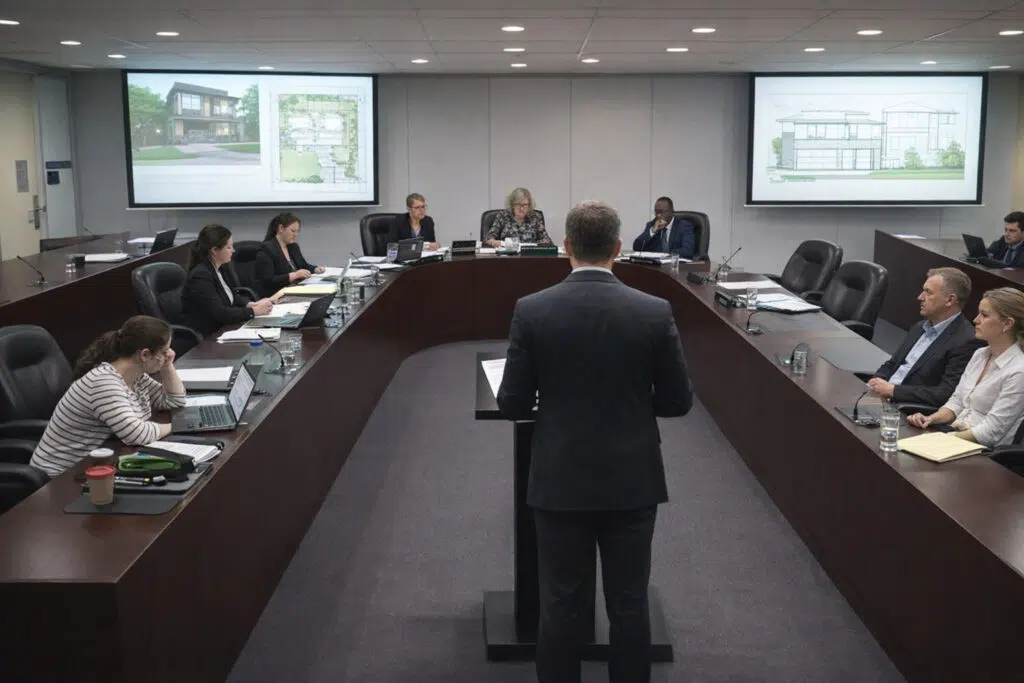
How the Committee of Adjustment process works in Toronto
The process usually begins with a zoning review and design assessment. If the proposal cannot proceed as-of-right, the team prepares a Committee of Adjustment submission package. Toronto currently accepts minor variance and consent applications in digital PDF format by email, and the City notes that a complete submission helps expedite evaluation and scheduling.
A typical process looks like this:
1. Zoning review and feasibility
The lot, bylaw standards, and proposed design are reviewed to identify exactly where relief is needed.
2. Drawings and supporting documents
The submission may include survey information, site plan, floor plans, elevations, zoning analysis, and a planning rationale.
3. Application submission
The application is submitted to the City with the appropriate forms and fees.
4. Notice and circulation
The City circulates the application for review and notice is provided for the hearing.
5. Hearing
The proposal is presented before the Committee of Adjustment, where support, questions, or objections may be raised.
6. Decision
The Committee makes a decision to approve, refuse, or approve with conditions.
7. Next approvals
If approved, the project can move ahead to the building permit stage, subject to any conditions or appeal periods.
Committee of Adjustment timeline in Toronto
The exact timeline depends on the complexity of the application, completeness of the package, neighbourhood concerns, and whether extra reports are needed. Xavieras’ Toronto construction timeframe content notes that Committee of Adjustment review can add roughly 1 to 3 months to a project timeline, while permit-related reviews for complex projects can take longer overall.
In real projects, the biggest causes of delay are usually not the hearing itself, but issues such as incomplete submissions, design revisions, tree-related requirements, heritage concerns, and weak planning justification. Toronto also states that a complete application checklist should be followed because complete submissions help speed evaluation and scheduling.
If you want a better idea of how approvals affect overall build duration, for more info check this page: Typical Construction Timeframe for Custom Home Building in Toronto
Committee of Adjustment fees in Toronto
For 2026, Toronto lists these fees for common residential applications:
- Minor variance for additions and alterations to existing dwellings with three units or less: $2,228.98
- Minor variance for residential dwellings with three units or less: $5,011.08
- After-the-fact variances: double the regular fee
Toronto also lists separate consent fees, with severance applications starting much higher.
These figures are only part of the total approval cost. Homeowners should also budget for surveys, architectural drawings, planning rationale, engineering where needed, arborist input where required, and permit-stage documents after approval.
Tree and site-related requirements many owners miss
One area many homeowners underestimate is the impact of tree rules and site documentation. Toronto states that all minor variance and consent applications must include specific tree-related materials, including a Tree Declaration Form, current site photos, and a site plan showing protected trees and protection zones where applicable.
This matters because a project that looks straightforward on paper can become more complicated when protected trees, ravine conditions, or neighbouring tree impacts are involved. In some neighbourhoods, this is one of the biggest hidden reasons approvals take longer than expected.
How to improve your chance of approval
The strongest Committee of Adjustment applications usually have three things: a realistic design, accurate drawings, and a clear rationale for why the requested variances are minor and appropriate in context.
Homeowners improve their odds when they:
- review zoning before design goes too far
- avoid overbuilding the lot without a clear planning basis
- prepare clean and accurate submission drawings
- address neighbourhood fit and built form early
- understand tree, heritage, grading, or other overlay issues before filing
- work with a design-build team that understands approvals strategy
Final thoughts
For many Toronto homeowners, the Committee of Adjustment is not a setback. It is simply part of the path to unlocking the right design for the property. The biggest difference is whether the project is approached strategically from the beginning. When zoning is reviewed early and the application is prepared properly, the process becomes much more manageable.
For custom homes, major renovations, and additions in Toronto, the smartest approach is to treat Committee of Adjustment planning as part of the overall design-build strategy, not as a last-minute fix after drawings are complete.
For official City guidance, application forms, and current fee details, for more info check this page: City of Toronto Committee of Adjustment Forms, Submission Guidelines & Fees